


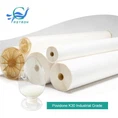
Pore-forming Agent
Why Choose Us?
High-quality Products
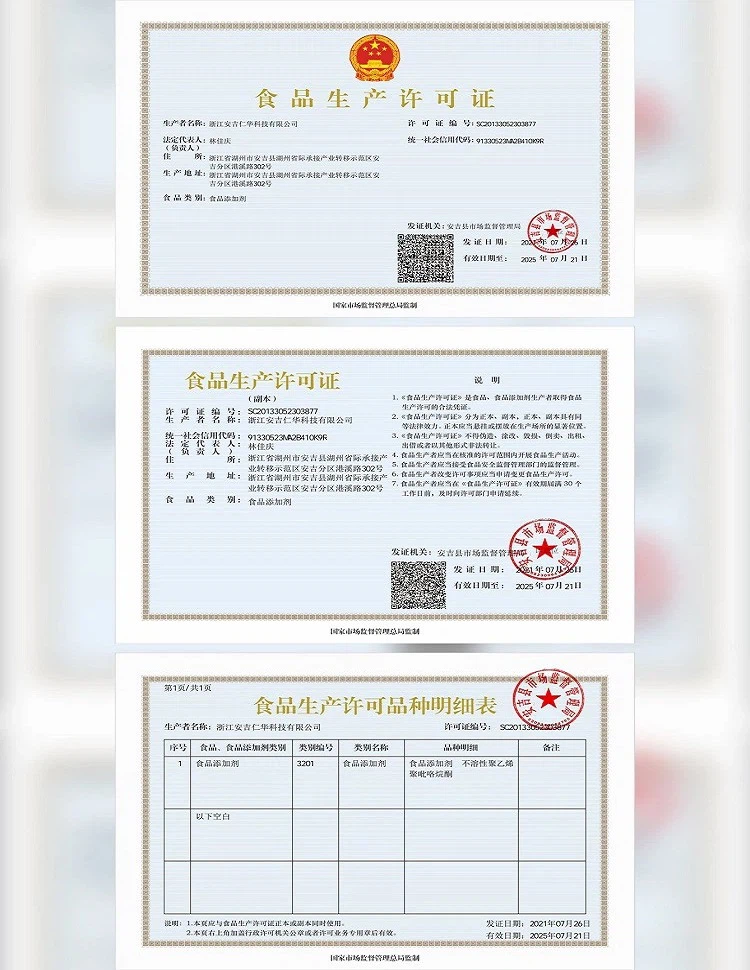
Its products lead the domestic market, achieving pharmaceutical-grade standards and completing the national filing of pharmaceutical excipients, obtaining food production permits. Strong commitment to quality with IS09001 certification and food production license.
Diverse Applications
After 8 years of research and development by the company's founding team, thecompany has formed multiple product series, including polyvinylpyrrolidone (PVP-K).crospovidone (PVPP), N-vinylpyrrolidone (NVP), Polymers with excellent propertiessuch as VP/A copolymer, PVP/A binary copolymer, and povidone-iodine (PVP-l). The products have diverse applications across various industries.
Rich Experience
Dedicated to strict quality control and attentive customer service, our experienced staff is always available to discuss your requirements and ensure complete customer satisfaction.
Competitive Pricing
We offer competitive pricing without compromising on quality, making our products accessible to a wide range of customers.
Definition of Pore-Forming Agent
Pore-forming agent is a pyrolysable material which burns out during firing. Preparation of porous ceramics with controlled microstructure can be made using different pore-forming agents such as wheat particles, starch, pmma, poppy seed and saw dust. Porous silica, a ceramic, was successfully synthesised using rice husk ash as the silica precursor via sol–gel process and employing yeast as the pore-forming agent. Yeast, a biological agent was added in increasing amounts to a sol–gel silica system at solution level along with additives such as glucose and water that allow the biological agent to multiply and grow and in the process form porous ceramic structure. The porous ceramic was dried in an oven at 110°c overnight. The resultant ceramic was characterised in terms of product density, particle size, surface area and pore volume using gas pycnometer and bet sorptometer respectively. The specific surface areas ranged from 163·4 to 200·7 m2 g–1 while for the pore volume the range was from 0·3410 to 0·4879 cm3 g–1.
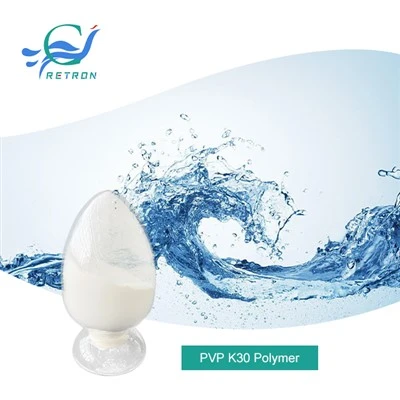


Highly adhesive polymer: Excellent tablet binding capacity at low concentrations producing hard, non-friable tablets.
Excellent solubility in water and non-polar solvents: Can be added as an aqueous or non-aqueous solution to wet granulation tablet processes.
Dissolves quickly: Does not delay disintegration or dissolution.
Low solution viscosity: Workable solution viscosity at high polymer levels makes it easy to use in granulation and other manufacturing equipment.
Non-ionic- solution: Viscosity is not affected by changes in ph or the presence of electrolytes, will not form complexes or interact with ionic drug actives.
Interfacially active: Acts as a drug solubilizer, inhibits crystallization of drug actives and inactive ingredients, stabilizes suspensions, dispersions and emulsions.
Pore-forming agents, often called porogens, increase interparticle porosity in shaped catalyst bodies. Starches, carbon black, sawdust, and flax have all been used to serve this purpose. Lubricants and plasticizers have a double role as they also act as pore-forming agents, resulting in a variety of meso- and macropores after their removal upon calcination. However, the effect of this type of additive in the pore architecture of shaped catalyst bodies has not yet been well understood due to a lack of the required visualization techniques.

What Is the Purpose of Using Pore-Forming Agent?
Among similar technologies, the pore-forming agent offers a highly promising alternative to conventional has hence attracted many researchers during the recent past. The pore-forming agent is defined as a thermally driven refrigeration technology for exploiting the heat from low-grade energy sources for cooling purposes.
Pore-forming agent of four main components, namely the generator, the condenser, the evaporator, and the absorber. Instead of using a compressor, the system uses pore-forming agent to rise and carry the weak coolant through a pump when the heat is supplied to the generator. In the evaporator, the refrigerant is vaporized upon absorbing the heat for the sake of cooling. The vapor is then absorbed by the weak solution that is actively cooled in the absorber. Next, the diluted solution is pumped to the generator where the refrigerant vapor is thermally desorbed from the solution and dispatched to the condenser where it is condensed. Thereafter, the liquid refrigerant phase expands to a lower pressure through an expansion valve and flows back to the evaporator to make up the evaporator refrigerant. At the same time, the strong solution is throttled back to the absorber through a heat exchanger to absorb the refrigerant vapor coming from the evaporator; this cycle is repeated during the process.
Porous Ceramic Materials by Pore-Forming Agent Method
Porous ceramic materials are used in several applications in many industrial and engineering fields namely filters and membranes, fuel cell electrodes, catalyst supports for biomaterials, piezo-electric materials, acoustically insulating bulk media. These materials often present low, fixed, and well defined thermal conductivity figures. Many different processes, have been reported in the literature in order to obtain porous ceramics: gelcasting process, organic foam technique, freeze casting method and pore-forming agent method. The latter is able to yield high porosity ceramics.
Porous ceramic materials can be produced by different techniques. One of the most important is pore agent method. The pore fraction, size, shape and distribution are linked to the pore-forming agent. In these materials porosity has a great influence in their physical properties and one of them is thermal conductivity. The role of the pore size distribution has been studied much less than pore fraction, probably because it is very difficult to describe and to characterize it. This model is capable to reproduce fractal or non-fractal microstructure. Calculated data are in good agreement with experimental ones. The model could be considered as a microstructure simulator to improve thermal performance of porous ceramic materials.
This method is based on the admixture of combustible additives which are burned out leaving a pore fraction into the ceramic matrix. In most cases, this step is followed by sintering which induces mechanical strength to the ceramics. High temperature treatment not only influences the total porosity but it also changes the micro-porosity of the products. The manufacturing process to be used in order to obtain these ceramics can be compaction or extrusion.
Compaction techniques are based on the application of a uniaxial or isostatic pressure to densify the powder bed. The pressure can be applied at room or high temperature. Whatever the compaction process is chosen, the porogen is uniformly mixed to the powder before compaction and, later on, porogen is further eliminated by heating. Thus, in the compaction process, pore fraction, size, shape and distribution are linked to the pore-forming agent.
In extrusion techniques, ceramic powders and pore-forming agent are mixed together. The resulting paste is molded using an extruder. Then, pore-forming agent is burned out and the samples are finally sintered. Often the final microstructure shows highly oriented cylindrical pores parallel to the extrusion direction.
One of the most pore-forming agent used is starch, but its application is limited to the production of large pores (5–50 μm). A good alternative is represented by polymers. They are very cheap and relatively sustainable. Furthermore, they are easily mixed with ceramic powder and burnt out at a moderately low temperature. Nevertheless, it is difficult to avoid that pore-forming agents determine an irregular and random microstructure. This way to increase porosity is particularly useful to control thermal conductivity value.
Materials and Methods of Pore-Forming Agent
Raw Materials
The raw materials were commercialized Al2O3 and rice husk waste. Sucrose solution was used as the binding agent since it is cheap and easily accessible.
Processing of Rice Husk Powder
To prepare the pore former in powdered form, rice husk was thoroughly washed to ensure removal of dust and later dried in an oven at 150 °C for 24 h to ease the pulverization process, which was performed using a laboratory blender. To enhance the purity of the ash residue, rice husk powder was dried, treated in HCl solution at 70 °C for 2 h and sieved for particle classification by employing American Standard for Testing Materials test sieves to obtain particle size ranges of <63 µm, 63–125 µm and 125–250 µm, which are the most compatible for the preparation of the porous alumina ceramics according to a preliminary study. Thermal analysis was performed using the TGA/Differential scanning calorimetry 1 HT analyzer at a rate of 5 °C/min.
Sample Preparation
A general formula of Al2O3-xRHy was utilized in expressing each sample composition, where 'x' denotes the particle size range in µm and 'y' denotes the percent weight content (wt%) of RH. The raw materials were ball-milled for 60 min in a planetary mono mill at 300 rpm in a container with 9 ceramic balls and mixed manually with sucrose solution. Thereafter, 4 g of the blend was uniaxially compacted in a steel die using a manual hydraulic press at a pressure of 95 MPa to promote the production of crack-free green compacts. Lastly, the green compacts were exposed to a two-step heat treatment process; (i) pore former decomposition performed at a rate of 1 °C/min with gradual temperature increase and dwell of 1 h, and (ii) sintering at 1450 °C.
Porosity Measurement
The density and porosity values of the pore-forming agent were measured using the water immersion method based on Archimedes' principle (the weighing of dry and water infused pore-forming agent in deionized water after boiling for 2 h and overnight cooling in water) with the following equations.
Microstructural Characterization
The microstructure and morphology of the pores were examined by field emission scanning electron microscope. By employing an image analysis software, the pores were measured by averaging the sizes of more than 50 pores from approximately five FESEM images per sample formulation.
Elemental and Phase Characterization
The chemical composition of the RHA was characterized using the Wavelength Dispersive X-ray Fluorescence Spectrometer and their quantitative chemical compositions were retrieved. The phase examination of the rice husk-shaped porous alumina ceramics was conducted using an X-ray diffractometer, under CuKα radiation at 40 kV and 40 mA.
Diametral Tensile Test
To ensure that the pore-forming agent were tested under plane stress conditions, a sample dimension of 18.5 mm × 4.5 mm was employed, which is in compliance with the geometry principle of 𝑡𝐷≤0.25 proposed in previous investigations. A universal testing machine operated at a speed rate of 0.1 mm/min as well as cardboard padding were utilized to perform the test and ensure uniform stress distribution, respectively. The diametral tensile strength was estimated using Equation. At least five pore-forming agent were tested, and the average value was reported.
Applications of Pore-Forming Agent
In the absorption refrigeration cycle, the refrigerant working fluid is a binary mixture. The pore-forming agent to absorb the refrigerant, then increases its pressure. The resulting solution continues in the cycle rejecting heat from the condenser at high pressure, then expanding and absorbing the heat in the evaporator at lower pressure.
Solar absorption refrigeration
In an ammonia water system or a Li Br – H2O absorption machine, the thermosyphonic system will serve as the generator.
Solar water pumping
The working fluid vaporised in the collector can be used for pumping directly by displacing the water to a higher elevation, while the volume reduction upon condensation corresponds with suction of the water from a well, e.g. the Boldt & the Birla pumps (8).
Generation of Mechanical (shaft) work
In a organic Rankine cycle motor, a higher efficiency is achieved through direct evaporation in the collector which plays the role of a boiler.
Domestic Water Heating
A DWH system which uses R-11 in the primary loop, with the heat of vaporisation of the refrigerant heating the water in a heat exchanger was developed (7). It demonstrated 83% energy recovery, which is appreciably higher than conventional system efficiencies.
Our Factory
Zhejiang Retron Biotech Co., Ltd. (referred to as Retron Biotech) is located in the town of Tianzi Lake, Anji County, which is the first county in China to receive the "United Nations Habitat Environment Award" and known as the "Hangzhou Back Garden". Retron Biotech was established in April 2021, covering an area of over 5.3 acres with a total investment of 28 million USD. It is a technology-based company specializing in the research and development, production, domestic and overseas business, and application technical services of polymer materials.
The company has obtained ISO 9001 Quality Management System certification, ISO 14001 Environmental Management System certification, and ISO 45001 Occupational Health and Safety Management System certification. Its products lead the domestic market, achieving pharmaceutical-grade standards and completing the national filing of pharmaceutical excipients, obtaining food production permits. The company's PVPP and PVP-K30 products have reached the highest versions of the EP10, USP43, and CP2020 standards in the international pharmacopoeias.


Our certificate


Ultimate FAQ Guide to Pore-Forming Agent
As one of the most professional pore-forming agent manufacturers and suppliers in China, we're featured by quality products and good service. Please rest assured to buy high-grade pore-forming agentmade in China here from our factory.
pore creating substance, sponge like material forming chemical, pore forming chemical