


Film Formation
Why Choose Us?
High-quality Products
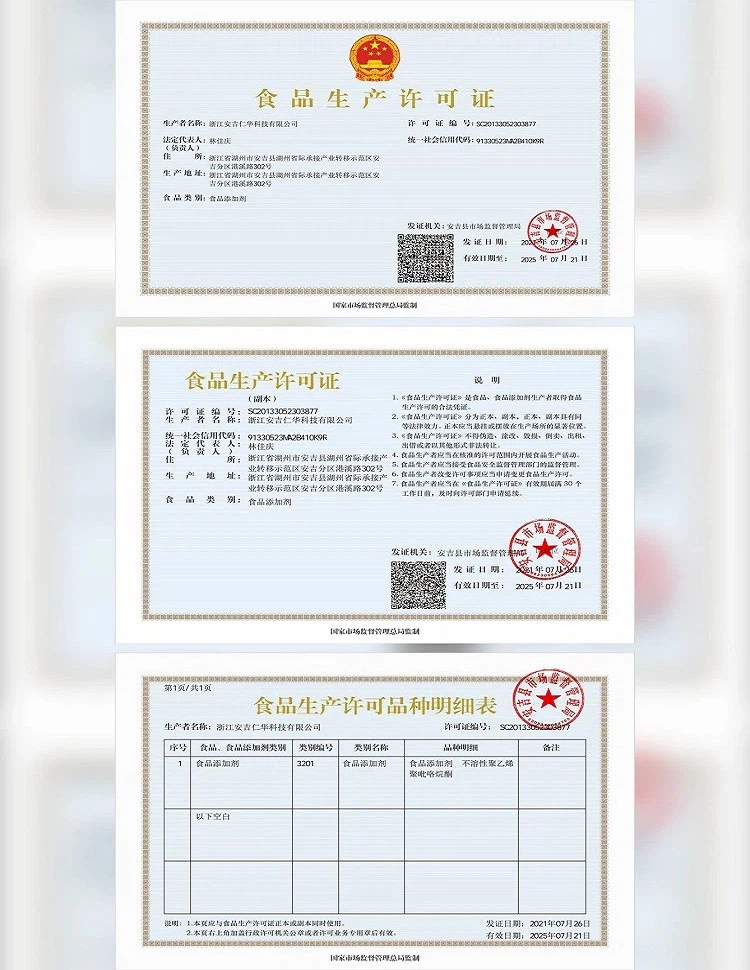
Its products lead the domestic market, achieving pharmaceutical-grade standards and completing the national filing of pharmaceutical excipients, obtaining food production permits. Strong commitment to quality with IS09001 certification and food production license.
Diverse Applications
After 8 years of research and development by the company's founding team, thecompany has formed multiple product series, including polyvinylpyrrolidone (PVP-K).crospovidone (PVPP), N-vinylpyrrolidone (NVP), Polymers with excellent propertiessuch as VP/A copolymer, PVP/A binary copolymer, and povidone-iodine (PVP-l). The products have diverse applications across various industries.
Rich Experience
Dedicated to strict quality control and attentive customer service, our experienced staff is always available to discuss your requirements and ensure complete customer satisfaction.
Competitive Pricing
We offer competitive pricing without compromising on quality, making our products accessible to a wide range of customers.
Definition of Film Formation
Put simply, the film formation is the process by which the applied paint becomes a coating. We can explain it thus: after the application of a fresh paint layer, the coating dries and the film formation takes place. The drying phase comprises the loss of solvent by evaporation and the crosslinking or curing process typical to a 2K polyurethane system. For solutions, where no binder particles are present, film formation occurs as the solvent evaporates, since the polymer chains are intimately mixed. Film formation from polymeric dispersions, however, requires the coalescence of individual polymer spheres or particles and interpenetration of the polymer chains. Films prepared from polymeric dispersions exhibit a minimum film forming temperature and processing conditions must exceed this temperature in order to form the film.


Extremely small particle size of copovidone results in:
● An improved dry binding capacity with excellent hardness, flowability, and plasticity.
● Production of very hard tablets with reduced friability.
● Less copovidone fine required to achieve the same degree of hardness of the tablets.
● No negative influence on the flowability of the finished powder formulation can be observed.
● Tablets with increased mechanical strength can be produced.
● Stability and Storage Conditions: Copovidone is stable and should be stored in a well-closed container in a cool, dry place.
What Is the Stability of Film Formation to Solvents?
1 g of capsule suspension was mixed with 9.3 g of water and 0.5 g of potassium iodide. To this was added 0.2g of the chosen solvent to give a catalyst solids content of around 2.00 % w/w in water, potassium iodide (0.05% w/w) and solvent (0.02% w/w). If an orange colour developed it indicated that the capsules were not stable against the solvent (this colour appeared immediately if the solvent released the catalyst from the capsule).
A polyurethane film forming coating system comprising:
A first component polyol resin; a curing agent catalyst substantially encapsulated within a carrier, said carrier dispersed in said polyol resin;
A second component crosslinking agent; wherein the combining of said first and second components initiates film formation and a substantial release of catalyst from said carrier upon application of said film forming coating system to a substrate.
A polyurethane coating system as recited in claim 1 or 2 wherein said catalyst comprises one or more of the following: Bismuth, mercury, tin, cobalt, calcium, cesium, zirconium, lithium, aluminum and zinc.
A polyurethane coating system as recited in any of the proceeding claims wherein said crosslinking agent is a polyisocycanate.
A polyurethane coating system as recited in any of the proceeding claims where said catalyst is an organometallic catalyst.
A polyurethane coating system as recited in any of the proceeding claims wherein said encapsulated catalyst is substantially resistant to hydrolysis until film formation.
A polyurethane coating system as recited in any of the proceeding claims wherein said encapsulated catalyst is substantially resistant to shear forces prior to film formation.
A polyurethane coating system as recited in any of the proceeding claims wherein said encapsulated catalyst is substantially resistant to heat prior to film formation.
A polyurethane coating system as recited in any of the proceeding claims wherein said base resin contains water.
A polyurethane coating system as recited in any of the proceeding claims wherein said carrier forms a complex comprising a plurality of catalyst containing microcapsules, said microcapsules having a polymeric outer layers comprised of a polyamide, a polysulfonamide, a polyester, a polycarbonate, a polyurethane, a polyurea polymer or mixtures thereof.
Film Formation's Working Significance for Capsules
This release of catalyst upon film formation can extend the pot life and shelf life of a curable film-forming composition when compared with a non-encapsulated catalyst. Accordingly, the cure speed can be modified by adjusting the amount of encapsulated catalyst, or catalyst content in the capsules, whilst having no or minimal effect on pot life as compared to traditional freely added catalyst.
For example, a bismuth-content of the encapsulated catalyst, when considered in terms of the quantity of elemental bismuth, is present in the two-component polyurethane composition according to the invention in a quantity of 0.0002 to 1% by weight, and in another example present in a quantity of 0.001 to 0.2% by weight, and in yet a further example in a quantity of 0.002 to 0.1% by weight, based on the weight of the composition.
The catalyst is associated with a capsule, or carrier. In the terms "microcapsule", "micro-capsule shell", "carrier", "capsule" and "encapsulant" means a small structure of any shape and texture containing a core or internal space that is enclosed within the structure. Film formation for capsules, the catalyst can be partially encapsulated in the structure such that the structure does not entirely enclose the catalyst within the core. In other embodiments, the carrier includes a solid matrix type capsule with the catalyst contained entirely or partially therein.
Process of Film Formation
Film formation refers to a process of forming a thin film on surfaces when film-forming materials, such as surface coatings, are applied on that surface. In the film formation process, a low-viscosity liquid surface coating is applied to a solid substrate. After curing this surface, it produces a solid, high molecular weight, polymer-based adherent film. This film protects a substrate from the attack of corrosive substances as well as corrosion.
Coatings are mostly liquid and possess a suitable viscosity to apply on a substrate. The liquid coating is transformed into a dry or solid film after application on materials. Powder coatings are also liquefied after application and transformed into a solid film. Both physical and chemical changes occur in the process, which is known as "film formation." The film formation process is critical to the final appearance and functionality of the coating.
Surface coatings are applied by spraying, brushing or through various industrial processes. This application gives a solid film after the evaporation of solvents from coatings. Surface coatings like paints, drying oils and varnishes, synthetic clear coatings, and other products are used to protect the surface of a material from the environment.
Films can be formed in a few different ways. The simplest way is to dissolve a polymer in solvents with necessary concentrations required for an application. After the application of a coating, solvents are allowed to evaporate and leave a dry film. Since the viscosity of coatings increases with the evaporation of solvents, the film will be dry to the touch soon after application.
In the case of lower-MW thermosetting resins coatings, less solvent is needed and many combinations of chemical reactions occur, which ultimately initiate polymerization and cross-linking to impart good film properties during the evaporation of solvents.
What Is the Film Formation on a Substrate?
There are a number of ways to produce effective, coherent films. The easiest to visualize is that of dissolving a polymer in a suitable volatile solvent, applying the coating and then allowing the solvent to evaporate. Solvent selection is vital in developing film integrity from solution polymers. Ideally a theta solvent-that is a solvent that completely dissolves the polymer-or a combination of solvents to produce complete dissolution should be employed. The polymer then exists as discrete polymer molecules in solution which are forced together as the solvent evaporates and the polymer concentration correspondingly increases.
Film formation requires that the polymer molecules remain mobile and stable, at least in the early stages of solvent evaporation and/or solvent absorption into the substrate. The result is a layer of polymer which is built up on the substrate. The solvent, or solvent mix, needs to solvate the polymer and resist precipitation of the polymer. If the polymer precipitates before film formation occurs, then the final coating may appear cloudy or powdery. In order to maintain good application properties, solution polymers are often formulated with low molecular weight species (less than 50 000) at low concentrations. In this respect, initial solvent release is not affected by the presence of the polymer. In solvent mixtures a highly volatile solvent may be employed to develop an early touch-dry coating. The remaining solvents need to be efficient in order to allow good film integrity
Initial solvent release is therefore a function of vapour pressure, temperature, surface area of the coating and air flow over the surface. However, as the relative polymer concentration increases, the solvent release is no longer controlled by evaporation but by diffusion through the polymer film. Total solvent release may not occur for hours, days or even years. Films may be initially plasticized by residual solvent but this could lead to brittle films over a period of time. Residual solvent may also be responsible for the development of cloudy or hazy films. Thermoplastic polymers are capable of flow under temperature. Heating can therefore improve film formation by further entanglement of polymer chains and by greater removal of residual solvent. Films formed from thermoplastic solution polymers are, by their nature of formation, susceptible to solvent attack. Excellent cohesion between coats can be obtained with solution polymers as a result of solvent penetration into the previous film.
Analytical techniques to evaluate film formation
● Differential Scanning Calorimetry (DSC) is adopted to calculate the MFFT of a polymer or emulsion system. It can also be used to calculate the Tg of the polymers as per ASTM E 1356 or ISO 16805. ASTM D 2354 and ISO 2115 test methods correspond to the DSC.
● Dynamic Mechanical Thermal Analysis (DMTA) including Dynamic Mechanical Analysis (DMA) is used to calculate Tg. These results can be correlated with DSC results.
Test methods to evaluate film formation
The test methods used to evaluate film formation are as follows:
● ASTM D 2354 — It determines the MFFT of emulsion vehicles.
● ISO 2115 — It determines the white point temperature and MFFT of polymer dispersions.


Storage instructions and stability of Film Formation:
● Store the unopened vials refrigerated at 2ºC to 8ºC. After reconstitution store PVP media solution at 2°C to 8°C. Discard 21 days after reconstitution.
● Do not freeze or expose to temperatures greater than 39°C.
● PVP Lyophilized is stable until the expiration date shown on the bottle label when stored as directed.
What Factors Affect Film Formation?
Glass transition temperature (Tg) of binder/polymer
The glass transition temperature is a parameter of polymeric emulsion, latex, or binder. Here, the latex starts to convert into a solid, hard, and brittle state.
● At low Tg, the polymer will be soft and rubbery at room temperature. It forms a film more easily.
● At high Tg, the polymer will be hard and brittle. This is due to limited mobility. It requires more effort to form the film. This means higher co-solvent levels or higher temperatures if baking or the use of a plasticizer is required.
Minimum film formation temperature (MFFT)
The MFFT is the minimum temperature at which the polymer/binder, or latex emulsion starts to coalesce or its particles start to fuse with each other. This leads to film formation. MFFT is one of the most critical factors which affects surface film formation.
If the temperature of application or curing is less than MFFT, then the continuous film formation will not occur and there will be cracks in the film. Polymer chain mobility which controls coalescence is dependent on MFFT.
Application conditions - Moisture & temperature
Application conditions have a major impact on surface film formation. Generally, a good, continuous surface film formation takes place at:
● Higher temperatures and
● Moderate humidity.
An increase in humidity can affect the film formation in a negative way. There can be wrinkling or scaling seen on film surfaces at higher humidity levels.
Optimization of formulation
A balanced formulation is the key to good film formation. The balance between the PVC, binder/polymer or emulsion content, surfactant, solvent or co-solvents, etc., plays a crucial role in film formation.
Binder chemistry & dosage
The nature of the emulsion and its content or dosage in formulation impacts the film formation.
● A lower Tg binder will have better film formation, but, it might result in a softer film.
● A higher Tg binder will need more effort to form film and it may lead to hard film. It will also need higher co-solvent/coalescent levels or higher temperatures.
Binder or polymer particle size also impacts the film formation. Higher particle size may result in non-continuous or less intact film formation, as compared to the fine particle size of emulsion polymers.
Presence of coalescent or co-solvent
Film formation especially in aqueous systems needs coalescence. This is due to the presence of moderate to high Tg emulsion polymer. Coalescent aid film formation in high humidity or low-temperature area or weathers. Examples of coalescent are glycol ethers, esters, or alcohol esters. Their primary role is to initiate the film formation by:
● Fusing or
● Deforming the polymer particles.
They also play a role in temporarily lowering the MFFT. This makes the film formation quicker. Different grades of coalescents or co-solvents are available in the market for different purposes. For example, lower VOC, alcohol-free, APEO/NPEO-free, etc.
Effect of Surfactants
Surfactants aid in film formation by giving a better application to the paint system. It also provides the leveling effect. A paint or coating system without an appropriate dosage of surfactant may suffer abrupt film formation. This can lead to adhesive failures. There is a wide range of surfactants that aid in superior wetting and film formation properties.
Our Factory
Zhejiang Retron Biotech Co., Ltd. (referred to as Retron Biotech) is located in the town of Tianzi Lake, Anji County, which is the first county in China to receive the "United Nations Habitat Environment Award" and known as the "Hangzhou Back Garden". Retron Biotech was established in April 2021, covering an area of over 5.3 acres with a total investment of 28 million USD. It is a technology-based company specializing in the research and development, production, domestic and overseas business, and application technical services of polymer materials.
The company has obtained ISO 9001 Quality Management System certification, ISO 14001 Environmental Management System certification, and ISO 45001 Occupational Health and Safety Management System certification. Its products lead the domestic market, achieving pharmaceutical-grade standards and completing the national filing of pharmaceutical excipients, obtaining food production permits. The company's PVPP and PVP-K30 products have reached the highest versions of the EP10, USP43, and CP2020 standards in the international pharmacopoeias.


Our certificate


Ultimate FAQ Guide to Film Formation
As one of the most professional film formation manufacturers and suppliers in China, we're featured by quality products and good service. Please rest assured to buy high-grade film formationmade in China here from our factory.
Excellent-Iodine, Crospovidone Disintegrated