


Adhesives
Why Choose Us?
High-quality Products
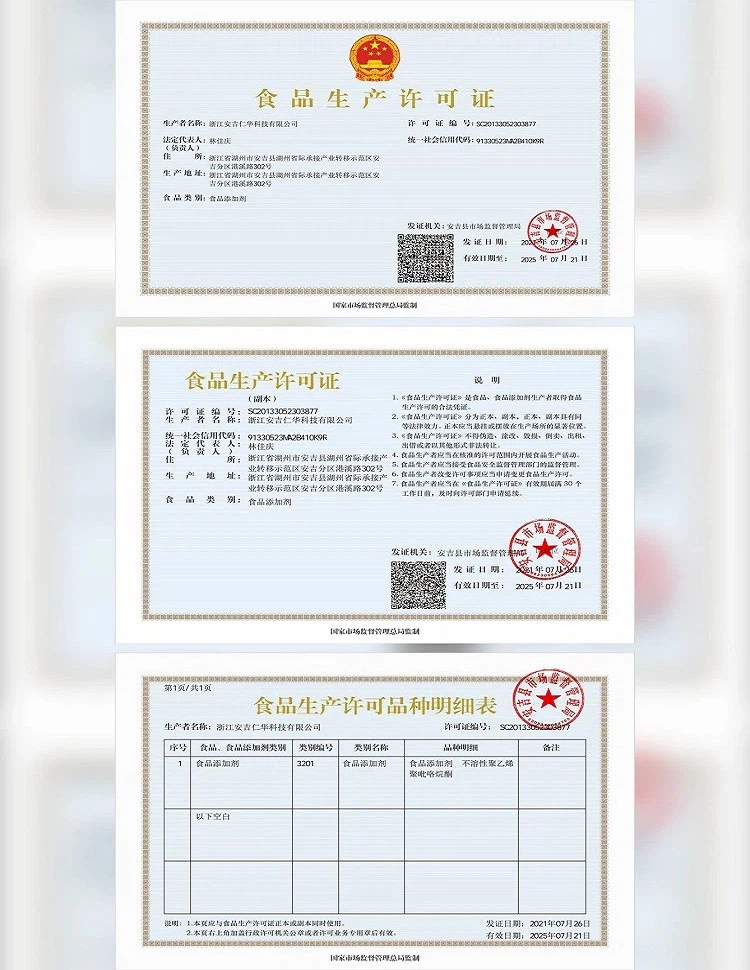
Its products lead the domestic market, achieving pharmaceutical-grade standards and completing the national filing of pharmaceutical excipients, obtaining food production permits. Strong commitment to quality with IS09001 certification and food production license.
Diverse Applications
After 8 years of research and development by the company's founding team, thecompany has formed multiple product series, including polyvinylpyrrolidone (PVP-K).crospovidone (PVPP), N-vinylpyrrolidone (NVP), Polymers with excellent propertiessuch as VP/A copolymer, PVP/A binary copolymer, and povidone-iodine (PVP-l). The products have diverse applications across various industries.
Rich Experience
Dedicated to strict quality control and attentive customer service, our experienced staff is always available to discuss your requirements and ensure complete customer satisfaction.
Competitive Pricing
We offer competitive pricing without compromising on quality, making our products accessible to a wide range of customers.
Definition of Adhesives
Adhesives, Substances that cause the adherence of two surfaces. They include glues (properly collagen-derived adhesives), mucilages, sticky pastes, gums, resins, or latex. Adhesion and polymer science form the essential foundation for all medical adhesives, sealants and sutures. These materials are utilized in all aspects of medical care to include bone healing, wound repair, tissue interface sealing and infection management among many others.


Adhesives is supplied as fine white or almost white powder. It has a slight characteristic odor and is practically tasteless. It is insoluble in all of the usual solvents.
● Super-disintegrant and dissolution enhancers to improve release characteristics of tablets, capsules and granules.
● Exceptionally fast release of active ingredients in solid dosage forms.
Adhesives: Where is Crospovidone Used?
Adhesives(Crospovidone) is a common, FDA-approved inactive ingredient used in the pharmaceutical industry. Crospovidone is often combined with active ingredients in medications and dietary supplements to allow absorption of the active drug. Adhesivesis considered a synthetic povidone analog. Chemically, crospovidone is an inert and insoluble white to light yellow free-flowing powder. It has hygroscopic, or water-attracting properties with excellent swelling characteristics. It is this swelling characteristic that makes it useful as a disintegrant in pharmaceutical dosage forms. Crospovidone is not absorbed orally. Oral use of crospovidone is not usually associated with toxicity in normal use as a pharmaceutical excipient. Pulmonary emboli have been reported in autopsies of intravenous drug abusers who have crushed tablets, such as hydromorphone, for injection. The long-term effects of crospovidone in the lung are unknown.
Crospovidone in adhesives is an insoluble polymer of N-vinyl-2-pyrrolidone that is used as a disintegrant in pharmaceutical tablets. It can potentially embolize to the lung when aqueous tablet suspensions are injected intravenously.
Suspected crospovidone was compared with pharmaceutical-grade crospovidone by means of histochemical stains, transmission electron microscopy, and infrared spectroscopy. Similar particles were also observed by light microscopy in a 4-mg tablet of hydromorphone, a preparation prescribed to two of the patients. Two patients had sickle cell disease and were taking methadone and/or hydromorphone for pain management; the third was receiving parenteral hyperalimentation after small bowel resection. Crospovidone in adhesives appeared as deeply basophilic, coral-like particles within pulmonary arteries and in extravascular foreign-body granulomas. Intrapulmonary crospovidone stained similarly to the pure substance, including intense staining with mucicarmine, Congo red, and Masson trichrome.
With Movat pentachrome stain, both intravascular and purified crospovidone appeared orange-yellow, whereas most interstitial particles associated with giant cells stained blue-green. Alcian blue failed to stain intravascular or purified crospovidone but strongly decorated some phagocytized particles. Ultrastructurally, both purified powder and tissue deposits of crospovidone appeared as irregular, electron dense, laminated, and finely granular material. Intrapulmonary crospovidone was associated with inflammatory cells and exhibited degenerative changes. By infrared spectroscopy, crospovidone in tissue had the same spectral characteristics as pharmaceutical grade crospovidone and the library reference, polyvinylpyrrolidone (PVP). We conclude that crospovidone contributes to pulmonary vascular injury in some persons who illicitly inject pharmaceutical tablets. It is readily identifiable histologically and distinguishable from other tablet constituents, such as cornstarch, talc, and microcrystalline cellulose. The variable staining with Alcian blue and Movat suggests that crospovidone is altered in vivo by the inflammatory response.

● High capillary activity and pronounced hydration capacity, with little tendency to form gels.
● Unlike other disintegrants, Crospovidone can enhance the release and the bioavailability of drugs through complex formation.
● Owing to high water-binding properties Crospovidone can stabilise water-sensitive drugs in solid dosage forms, e.g. in vitamin formulations.
● Highly compressible and particularly suited for actives or formulations with plastic or poorly compactible characteristics
Crospovidone grades are non-ionic, and thus do not form complexes with ionic drugs, which can impact drug release and/or stability for cationic drugs. Moreover, disintegration is unaffected by the pH of the medium.
● Yields smooth tablets.
Crospovidone as adhesivesis unique among superdisintegrants because it acts via multiple disintegration mechanisms including swelling, and wicking followed by secondary swelling.
In general, an increase in particle size improves the disintegration and dissolution of tablets. This effect is attributed to the efficient formation of hydrophilic networks by larger size particles.
Like other disintegrants, crospovidone as adhesivesis is more effective if used both intra- and extra-granularly. In general, disintegrants added exclusively intra-granularly are not as effective as that added extra-granularly.
Storage conditions do not appear to affect the water uptake and force development for crospovidone as adhesivesis as much as they do for sodium starch glycolate.
The presence of other excipients such as lubricants can impact the efficiency of disintegrants. This is especially the case with lubricants, which can interfere with wetting and water entry.
The solubility of excipients also has an impact on how efficient disintegration proceeds. Generally, insoluble excipients enhance disintegration and dissolution.
What Are the Storage Precautions of Adhesives (Drugs)?
Teens who misuse medicine adhesives most often get them from their own home, a relative's home or a friend's home. Take opportunities to talk with kids and teens about the dangers of taking medicine that is not prescribed to them.
The safest way to keep medicine adhesives stored is to lock them up where others cannot access them. Lock up medicines in a safe, cabinet or lockable box. Store refrigerated medicine in a lockable box, away from food items.
Note the number of pills in bottles and pill packets, and keep track of use and refills. As your child gets older, supervise them as they start taking their own medicines. If your child or teen has a prescription for pain medicine, an adult should give them the proper amount as needed and track doses on a log. Some families do this for adhd, anxiety and other medicine adhesives as well.
No longer need a medicine? Is any medicine at home expired? Safely dispose of it as soon as possible by using one of the methods below. In the meantime, securely lock it up.
● Participate in adhesives (drugs) take-back day.
● Use a medicine disposal kiosk or adhesives (drugs) mail-back.
● Ask at your pharmacy, local police or sheriff station if they will accept prescription medicines, or know where you can dispose of them.
● Use 'disposer' if your pharmacy gave you a package of this disposal product.
If these options are not available, dispose of unused medicines by following these steps:
● Fill a container with some water. Make sure the container has a lid.
● Add something inedible to the container like cat litter or coffee grounds.
● Add whole pills to the mixture.
● Tape the container lid shut and seal it in a bag.
● Place the container in the garbage close to trash collection day.
● Make sure that the trash is not easy for people or pets to access.
● Do not flush medicine adhesives down the drain or toilet. This protects the environment by keeping harmful substances out of the water supply.
● Never share medicines with anyone else.
● Be sure to remove any personal information from prescription bottles or pill packages before you throw away the container.
● Encourage friends, relatives and neighbors to safely store and dispose of their medicine adhesives, too.
Micronised Crospovidone (Type B) can be added in concentrations of 5 – 12% to oral and topical suspensions to stabilise oral and topical formulations. This grade achieves this effect by increasing the volume of the sediment and reducing its sedimentation rate, and by making it easy to redisperse the sediment by shaking (anticaking effect). These effects are achieved without increasing the formulation's viscosity.
The ability to stabilise suspensions without increasing thickness is particularly useful in ready-to-use suspension or an instant drink-type powder or granulate formats that require the consumer to prepare before use.
The addition of electrolytes such as sodium citrate as well as xanthan gum or sugar syrups is recommended as it increases the sediment volume achieved with Crospovidone as Adhesives in these formulations.

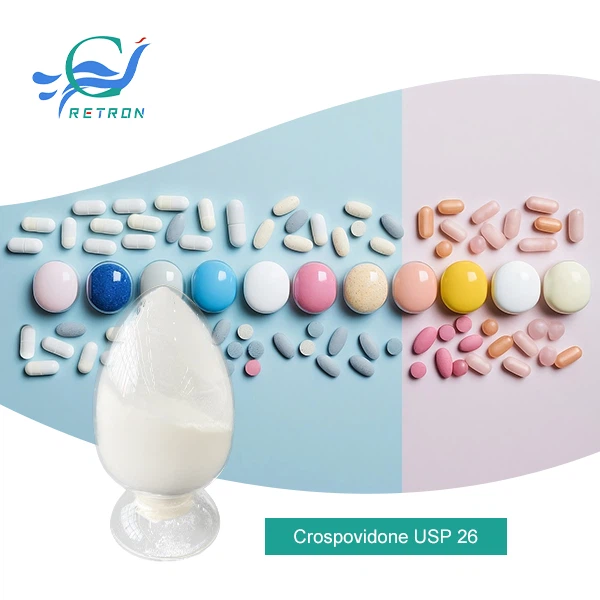
Adhesives(Crospovidone) grades are used in pharmaceutical formulations on account of their swelling properties, porosity and insolubility. The different uses include:
● Superdisintegrants for fast and efficient tablet disintegration.
● Drug release and bioavailability enhancement of certain active ingredients through complexation.
● Stabilisers for suspensions through the ability to form flocs.
What Are the Different Types of Crospovidone as Adhesives?
|
Type A |
Type B |
|
|
Grade |
Standard |
Super Fine |
|
Particle size (µ) |
40 – 140 |
30 – 100 |
|
Swelling pressure (kPa) |
170 |
25 |
Disintegration mechanism and water absorption ratio The disintegration mechanism of the disintegrants used was demonstrated by the change in appearance of tablets observed during the wetting test. Tablets containing the swellable disintegrants; PPA, SSG with or without CS and crospovidone showed a significant swelling. The degree of swelling as measured by the water AR was significantly higher for tablets containing PPA or SSG with/without CS (ANOVA, post hoc, P < 0.0001). The AR for PPA and SSG was 2.1 and 2.8, respectively.
Interestingly, crospovidone as adhesives had a lower AR of 0.88 although this was significantly higher than the AR of ≤0.62 observed for the non-swelling or osmotic disintegrants; CS, citric acid or sodium citrate. Crospovidone as adhesives disintegrants are reported to act by a wicking mechanism; drawing water into the tablet through capillary action due to its porous particle morphology, resulting in secondary swelling and rupture of interparticulate bonds and in tablet disintegration.
What Are the Applications of Adhesives?
Crospovidone as Adhesives is an insoluble form of polyvinylpyrrolidone, and its use in the pharmaceutical industry as a tablet excipient (a tablet disintegrant and binder) has been widely documented. It is medically used for the treatment of some intestinal disorders as solubilizing excipients to improve the bioavailability of drugs (such as steroids) and as germicides in wound treatment. It is also commonly used as a clarifier in alcoholic and nonalcoholic beverages. The primary pharmaceutical application of Crospovidone as Adhesives is that of a tablet disintegrant, although it can also function as a tablet binder. For a polymer to be useful as a pharmaceutical excipient, grades of material need to possess properties such as high swelling capacity, high capillary activity, high hydration capacity, and low bulk density. The chapter discusses the interactions of Crospovidone as Adhesives with drug substances.
Our Factory
Zhejiang Retron Biotech Co., Ltd. (referred to as Retron Biotech) is located in the town of Tianzi Lake, Anji County, which is the first county in China to receive the "United Nations Habitat Environment Award" and known as the "Hangzhou Back Garden". Retron Biotech was established in April 2021, covering an area of over 5.3 acres with a total investment of 28 million USD. It is a technology-based company specializing in the research and development, production, domestic and overseas business, and application technical services of polymer materials.
The company has obtained ISO 9001 Quality Management System certification, ISO 14001 Environmental Management System certification, and ISO 45001 Occupational Health and Safety Management System certification. Its products lead the domestic market, achieving pharmaceutical-grade standards and completing the national filing of pharmaceutical excipients, obtaining food production permits. The company's PVPP and PVP-K30 products have reached the highest versions of the EP10, USP43, and CP2020 standards in the international pharmacopoeias.


Our certificate


Ultimate FAQ Guide to Adhesives
As one of the most professional adhesives manufacturers and suppliers in China, we're featured by quality products and good service. Please rest assured to buy high-grade adhesivesmade in China here from our factory.
transparent glues, glue for anaerobic, odorless adhesives